Glossary
Cross-Default
A cross-default is a loan provision under which a default on one loan or property automatically triggers a default on other loans held by the same borrower. It links otherwise separate obligations, so one missed payment or covenant breach can place an entire portfolio into default at once.
How a Cross-Default Works
A cross-default is triggered when the borrower defaults on a separate obligation, not when the called loan itself fails. Lenders draft it two ways: a broad standalone clause, or a specific entry in the events-of-default section that names the linked loan by date, amount, and collateral. The second form is stronger for enforcement.

The law firm Messerli Kramer, writing as lenders' counsel, describes the stronger method as placing the cross-default inside the events-of-default section and referencing the other loan "by date, amount, collateral secured by the loan, and other defining characteristics." That specificity gives the lender a cleaner basis to act when the only event of default is a failure on the cross-defaulted loan.
Two structural questions decide how far the clause reaches:
Drafting choice | Effect |
|---|---|
Same lender only vs any creditor | Whether a default owed to a third party can trip the current loan |
All borrower loans vs one named loan | Whether the clause sweeps in every facility or a single specified note |
Borrower only vs guarantors and principals | Whether defaults by common sponsors or special-purpose affiliates count |
Because many borrowers hold each asset in a separate special-purpose entity, Messerli Kramer advises lenders to draft cross-default language that reaches guarantors and common principals, otherwise the clause may not bind the sponsor behind the entities.
Why a Cross-Default Matters
A cross-default is a contagion mechanism: it converts trouble at one asset into a default across every loan the clause reaches. For a sponsor holding several properties under one lender, a single vacancy-driven covenant breach can accelerate all of the notes, not one. That concentration of risk is the point of the clause and the danger for the borrower.
For an operator, the practical stakes are acceleration and cross-collateral exposure. A performing property can be pulled into a workout because a sibling asset stumbled. In a portfolio financed through a single lender relationship, the effective loan-to-value and coverage tests should be read at the portfolio level, not deal by deal, because the weakest asset sets the trigger for all of them.
One quotable rule: a cross-default clause means the health of your worst asset, not your average asset, determines whether your best loans stay current.
Example
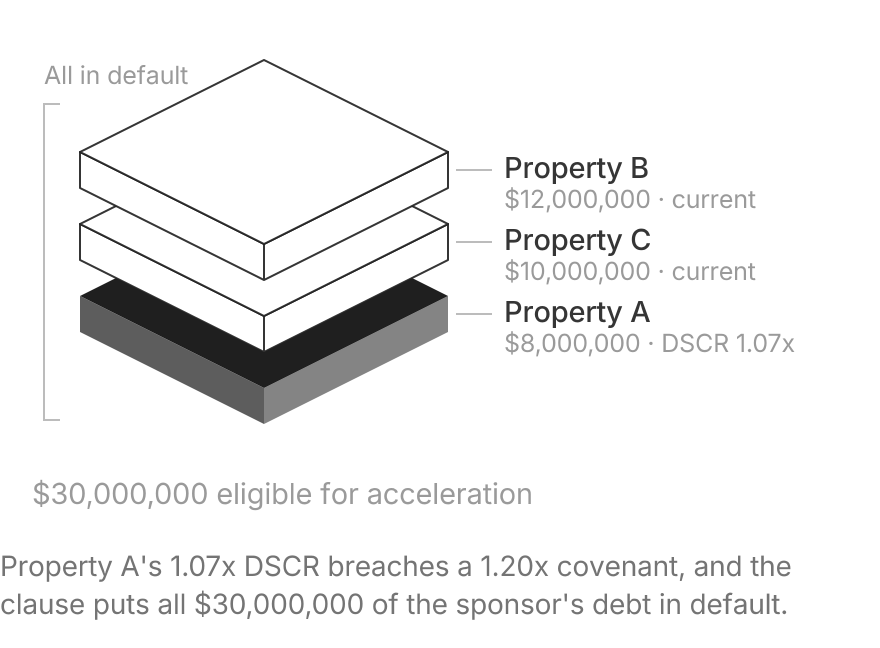
A sponsor holds three properties financed by the same lender under a shared cross-default clause. Property A's net operating income falls to $960,000 against $900,000 of annual debt service, a debt service coverage ratio of 1.07x. The loan requires a minimum DSCR of 1.20x, so Property A is in technical default. The cross-default clause converts that single breach into a default on all three loans.
Asset | Loan balance | Status before breach | Status after cross-default |
|---|---|---|---|
Property A | $8,000,000 | DSCR 1.07x, below 1.20x covenant | Event of default |
Property B | $12,000,000 | Current, covenants met | Default, subject to acceleration |
Property C | $10,000,000 | Current, covenants met | Default, subject to acceleration |
Total | $30,000,000 | One asset impaired | $30,000,000 eligible for acceleration |
A $60,000 coverage shortfall on one building exposes $30,000,000 of debt to acceleration. Nothing changed at Property B or C, yet both are now in default because the clause links them to Property A.
Variations and Edge Cases
A cross-default is not uniform across loan documents. Scope varies from a single named loan to every obligation the borrower owes, and some clauses extend to debts owed to unrelated creditors, so a default on a bank line can trip a mortgage. Cure periods, materiality thresholds, and carve-outs for good-faith disputes all narrow how easily the trigger fires.
In securitized debt, cross-default frequently appears alongside cross-collateralization. Rating agencies and issuers treat a pool of same-sponsor properties that is both cross-defaulted and cross-collateralized as a form of credit enhancement, because the structure concentrates the sponsor's incentive to keep every asset current. Borrowers negotiating these clauses often seek release provisions that let an individual property be sold or refinanced out of the pool without tripping the rest.
Cross-Default vs Cross-Collateralization
Cross-default is often confused with cross-collateralization. Cross-default is an enforcement link: a default on one loan counts as a default on another. Cross-collateralization is a security link: the same collateral secures more than one loan. According to HCMP Law Offices, a cross-collateralization clause "generally provides that the same collateral, often real property, secures multiple loans from the same lender," while a cross-default clause "provides that an event of default under one loan constitutes an event of default under a separate loan."
Feature | Cross-Default | Cross-Collateralization |
|---|---|---|
What it links | Default status across loans | Collateral across loans |
Question it answers | When can the lender declare default | What property backs each loan |
Common label | Cross-default clause | Dragnet clause |
HCMP notes the two usually appear together, but when they stand alone the cross-default clause is the more common of the two, especially where the lender already holds other security.
Frequently Asked Questions
Does a cross-default require the borrower to miss a payment on the second loan? No. A cross-default fires on the default of a separate loan even when the current loan is fully performing. The trigger is the other loan's default status, not a new failure on the loan being called.
Can a cross-default reach loans from a different lender? Yes, if the clause is drafted that way. Some cross-default provisions extend to any indebtedness the borrower owes, so a default owed to a third party can trip a mortgage. Others are limited to loans held by the same lender.
How do borrowers limit cross-default risk? Borrowers negotiate materiality thresholds, cure periods, and property-release provisions, and they separate financings across different lenders so one relationship cannot pull the whole portfolio into default.