Every commercial real estate acquisitions team faces the same problem: too many deals to evaluate and too little time to evaluate them properly. A typical shop might see 500 opportunities per year but close fewer than 20. The math implies that most deals deserve rejection, and the faster that rejection happens, the more time remains for deals that actually merit attention.
Deal screening is the process of filtering opportunities before committing full underwriting resources. It answers a threshold question: does this deal warrant the hours (or days) required to build a model, abstract the leases, and develop conviction? Historically, even this preliminary assessment required meaningful effort. Someone had to open the offering memorandum, scan the rent roll, estimate the return profile, and make a judgment call. Multiply that by hundreds of deals per year, and screening itself becomes a substantial time sink.
AI is compressing the screening phase. Initial data extraction, return estimation, and red flag identification can now happen in minutes rather than hours. This compression does not replace human judgment about which deals to pursue. It accelerates the delivery of information that supports that judgment.
The Traditional Screening Bottleneck
In a traditional workflow, deal screening unfolds slowly. A broker sends an offering memorandum. An analyst opens it, reads the executive summary, scrolls through the rent roll, and eyeballs the financials. They estimate a rough cap rate, compare it to their target returns, and flag any obvious issues (short lease term, concentrated tenancy, unfamiliar market). Based on this review, they recommend whether to request additional information or pass.
This process takes 30 minutes to an hour per deal when done conscientiously. When deal flow is heavy, analysts either rush through screenings (missing important details) or fall behind (letting opportunities sit unreviewed while competitors engage). Neither outcome is acceptable.
The bottleneck is not decision-making. It is information assembly. The analyst's judgment about whether to pursue a deal takes seconds once they have the relevant facts. Gathering those facts from scattered PDF pages is what consumes time.

What AI Enables at the Screening Stage
AI-powered extraction can pull screening-critical data from offering memorandums, rent rolls, and operating statements within minutes of receiving documents. This shifts the analyst's task from information gathering to information review.
A well-configured screening workflow extracts and presents:
Data Point | Source | Screening Purpose |
|---|---|---|
Property type and location | OM cover, property description | Market fit, geographic strategy alignment |
Asking price and price per SF/unit | OM summary | Initial valuation sanity check |
In-place NOI | OM financials, T-12 | Return profile estimation |
Occupancy rate | Rent roll | Stabilization risk assessment |
Tenant count and concentration | Rent roll | Single-tenant vs. diversified risk |
Weighted average lease term | Rent roll | Rollover exposure |
Largest tenant(s) and lease expirations | Rent roll | Near-term re-leasing risk |
Seller's projected returns | OM financials | Expectation calibration |
With these data points assembled automatically, the analyst reviews a structured summary rather than hunting through documents. The screening decision that previously required 45 minutes now requires 10.
The Screening Workflow With AI
An AI-enabled screening workflow follows a defined sequence.
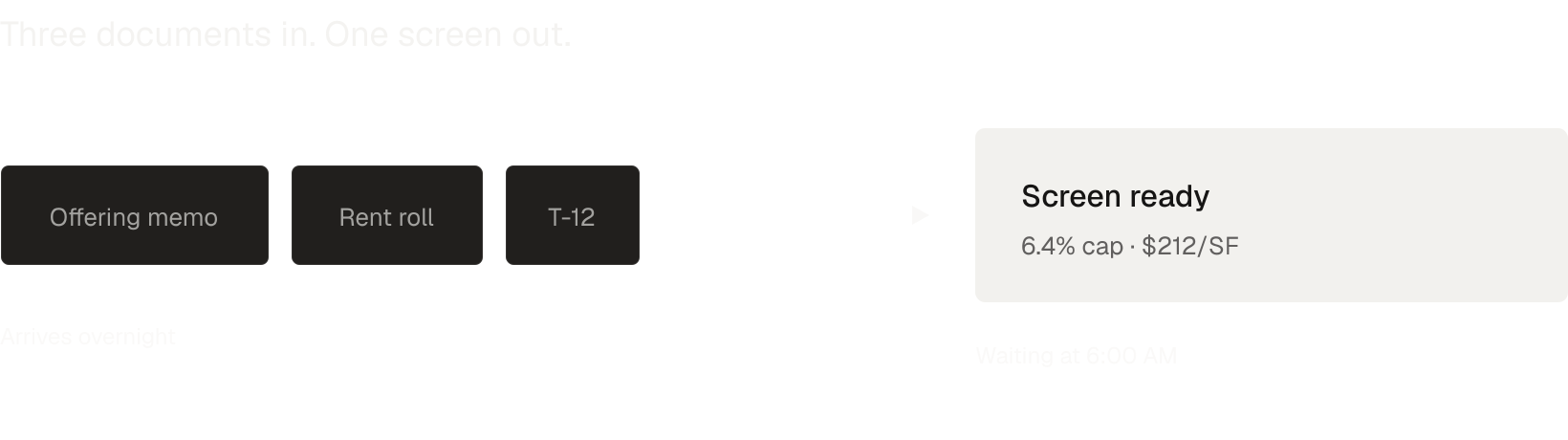
Step 1: Ingest and classify. Documents arrive (usually via email from a broker or through a deal management platform). The system identifies document types (offering memorandum, rent roll, T-12) and routes them for appropriate extraction.
Step 2: Extract screening fields. AI pulls the specific data points needed for initial evaluation. This extraction is narrower than full underwriting abstraction. The goal is speed, not completeness. Fields that matter for screening get priority. Fields that matter only for deep diligence wait.
Step 3: Calculate derived metrics. Raw extracted values feed into calculations: implied cap rate (NOI divided by asking price), price per square foot, occupancy percentage, weighted average lease term. These derived metrics enable comparison across opportunities without manual computation.
Step 4: Apply screening filters. Predefined criteria flag deals that fall outside target parameters. If the firm only pursues deals above $20 million, below 8% cap rate, or in specific markets, the system can surface mismatches immediately. This does not auto-reject deals but highlights where they deviate from stated strategy.
Step 5: Present screening summary. The analyst receives a one-page summary with extracted data, calculated metrics, and flagged criteria. They review this summary, not the underlying documents, for the initial pass/pursue decision.
Step 6: Decide and route. Based on the summary, the analyst decides to pass (with documented reason), request additional information, or advance to full underwriting. The decision and rationale are logged for future reference.
What Screening Catches (and What It Misses)
AI-enabled screening excels at catching quantifiable mismatches and obvious red flags.
Deals that fail threshold criteria. A firm targeting $15 to $50 million acquisitions receives a $200 million portfolio opportunity. Screening flags the size mismatch before anyone spends time on detailed review.
Return profiles that do not pencil. A seller's asking price implies a 5.5% cap rate. The firm's cost of capital requires 6.5% to meet return hurdles. Screening surfaces this gap immediately, prompting either a pass or a strategy to negotiate price down.
Concentration risk. A rent roll shows one tenant representing 70% of base rent with a lease expiring in 18 months. Screening highlights this exposure before the analyst discovers it on page 47 of the offering memorandum.
Near-term rollover. Weighted average lease term of 2.3 years on a stabilized acquisition signals re-leasing risk that may not fit the firm's appetite for transitional assets.
Screening does not catch issues that require interpretation or investigation:
Tenant credit quality (requires research beyond the rent roll)
Physical condition (requires inspection or PCA review)
Market dynamics (requires local knowledge or research)
Seller motivation and deal context (requires broker conversation)
Hidden lease provisions (requires full abstraction)
Screening filters the obvious. Diligence uncovers the subtle.
Real-World Screening Scenarios
Consider how AI-enabled screening changes outcomes in practice.
Scenario 1: The off-market flood. A broker sends eight off-market opportunities in a single week, each with an OM and rent roll. Traditionally, reviewing all eight would consume most of an analyst's week. With AI-enabled screening, summaries for all eight are available within an hour. The analyst identifies two that fit the firm's criteria, passes on five that miss on size or market, and flags one for follow-up questions about an unusual tenant mix. The broker receives responses within 24 hours, strengthening the relationship.
Scenario 2: The attractive headline, disappointing details. An OM headline promotes a "stabilized office asset with strong in-place cash flow." The AI-extracted rent roll reveals 82% occupancy with the two largest tenants (representing 40% of rent) expiring within 14 months. Screening surfaces this discrepancy before the analyst is seduced by the marketing narrative. The deal is either passed or reframed as a value-add opportunity rather than a stabilized acquisition.
Scenario 3: The hidden gem. A deal arrives with a bland OM and minimal marketing effort. The seller is a family office seeking a quiet disposition. AI-extracted data shows strong NOI, long weighted average lease term, and an asking price implying an above-market cap rate. Screening elevates this opportunity for immediate attention despite its unremarkable presentation.
What "Done" Looks Like
Effective AI-enabled screening meets the following standards:
Every inbound opportunity receives a structured screening summary within 24 hours of document receipt.
Screening summaries contain all data points necessary for initial pass/pursue decisions.
Predefined filters flag deals that deviate from stated investment criteria.
Pass decisions include documented rationale, creating a searchable record of opportunities declined and why.
Pursue decisions advance to full underwriting with screening data pre-populated, eliminating duplicate extraction.
Screening throughput matches deal flow volume without analyst overtime or backlog accumulation.
If screening summaries are delayed, incomplete, or ignored in favor of manual document review, the workflow is not functioning.
Common Screening Failures and Prevention
Even with AI, screening workflows can fail.
Over-filtering. Overly rigid criteria reject deals that deserve nuanced consideration. A deal slightly below size threshold in a high-conviction market might warrant pursuit despite the mismatch. Prevention: use filters to flag, not auto-reject. Human judgment makes final decisions.
Under-extraction. Screening summaries omit data points that matter for the firm's specific strategy. Prevention: configure extraction to capture the fields your investment criteria actually require, not generic defaults.
Summary neglect. Analysts distrust AI outputs and revert to manual document review, negating time savings. Prevention: validate extraction accuracy during implementation, build analyst confidence through demonstrated reliability, and address errors promptly when they occur.
Decision drift. Screening decisions are made but not documented, losing the institutional memory of why deals were passed. Prevention: require documented rationale for every pass decision, stored in a searchable system.
Conclusion
Deal screening determines how efficiently an acquisitions team allocates its most constrained resource: human attention. AI compresses the information-gathering phase of screening, delivering structured summaries that enable faster, more consistent pass/pursue decisions. This compression does not automate judgment. It accelerates the delivery of facts that inform judgment. The result is a team that responds to opportunities faster, filters deal flow more effectively, and reserves deep underwriting effort for deals that genuinely merit it.
Related Reading
Break-Even Occupancy Is the Number That Tells You How Much Room a Deal Has
Offering Memorandum Extraction: Why Manual Data Entry Is the Hidden Tax on Every Acquisitions Team
Pro Forma Optimism: The Five Assumptions Buyers Should Always Challenge
The Offering Memorandum Is a Marketing Document, So Read It Like One
The First-Look Decision: Compressing Initial Screening From Days to Minutes